


Window Apertures in Period Houses
A window has two main parts; the opening or aperture, and the frame carrying the glazing. See the glossary section for more terms.
These examples show the variety of window openings. The first set shows examples of the head, formed with a lintel or arch or a combination of these:
 stone lintel and spreader arch, with dog-tooth infill (mid-Victorian)
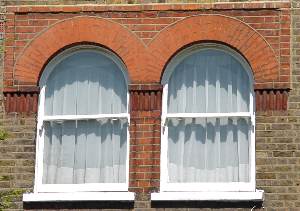 brick arch
The construction of the jambs and reveals (to the sides), and mullions separating the lights can be in brick or stone and may be decorated with columns:
 stone jambs and stone mullion with column
 late Victorian bay with stone jambs and stone mullions with pilasters
 gable window with undecorated brick jambs
 bay with brick jambs and mullions with stone capitals; the capitals were usually carved rather than cast